Ground Rules: Understanding the Environmental and Geological Risks Beneath American Homes
Japan is one of the most seismically active nations on earth. Its building codes are among the most rigorous anywhere. Its citizens grow up with an acute awareness of what the ground beneath them can do. For Japanese buyers arriving in the United States, this background can feel like preparation—a head start in evaluating whether a home is built to withstand what nature may bring.
In many respects, that awareness is genuinely valuable. But it can also create a false sense of coverage.
American land risks are not simply a softer version of Japanese ones. They are, in many cases, an entirely different category of problem—shaped by different geology, different climate systems, and a regulatory environment that does not always require disclosure of what lies beneath a property's surface. Flooding patterns, expansive soils, legacy contamination, and regional subsidence are hazards that a Japanese buyer's seismic intuition does not automatically address.
Understanding the ground beneath an American home is one of the most important—and most frequently skipped—steps in the purchase process.
Flood Risk: More Pervasive Than Most Buyers Expect
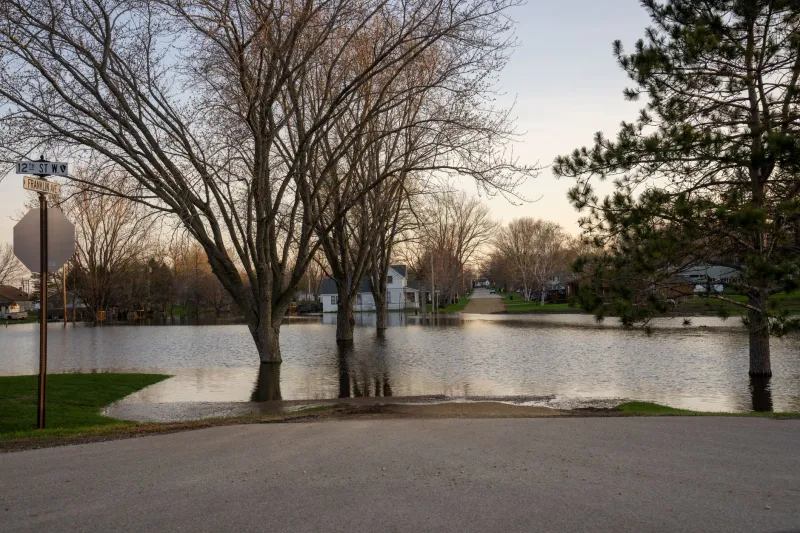
Flooding is the most common and most financially damaging natural disaster in the United States. It affects properties in every state, including many that buyers would not intuitively associate with flood risk. Inland flooding from rivers, flash flooding in arid regions after sudden rainfall, and coastal inundation from storm surge all represent distinct mechanisms with different implications for property value and insurability.
The Federal Emergency Management Agency (FEMA) maintains flood insurance rate maps that classify land into risk zones. Properties located within a Special Flood Hazard Area—commonly referred to as a 100-year flood zone—are required by most mortgage lenders to carry flood insurance, which is purchased separately from standard homeowner's insurance and can be substantially expensive.
However, flood maps have significant limitations. They are updated infrequently, and climate-driven changes in precipitation patterns have rendered many older maps inaccurate. Properties just outside a designated flood zone may still experience regular flooding; properties within the zone may have been substantially elevated or flood-proofed. The map is a starting point, not a verdict.
Before purchasing any property, particularly in coastal areas, river corridors, or regions with documented flash flood history, Japanese buyers should:
- Obtain the current FEMA flood zone designation for the specific parcel
- Review historical flood claims through a CLUE (Comprehensive Loss Underwriting Exchange) report
- Consult with a local flood insurance agent about current premium rates for the property
- Ask neighbors directly about their experience with water intrusion during heavy rainfall
Soil Composition: The Risk You Cannot See
American soils vary dramatically by region, and some of that variation has direct consequences for residential construction and long-term structural stability.
Expansive clay soils, common across Texas, Colorado, the Mid-Atlantic states, and portions of California, expand when wet and contract when dry. This seasonal movement exerts significant pressure on foundations, causing cracking, shifting, and in severe cases, structural failure. Homes built on expansive clay without appropriate engineering countermeasures can develop foundation problems that are expensive to remediate and difficult to fully resolve.
For Japanese buyers accustomed to building standards designed around seismic performance—which typically include deep, reinforced foundations—the idea that soil movement unrelated to earthquakes could compromise a structure may not be immediately intuitive. A standard home inspection will note visible foundation cracking but may not diagnose its underlying cause. A separate structural or geotechnical assessment is often warranted in high-clay regions.
Fill soil presents a different category of concern. Many American residential developments, particularly those built on former wetlands, hillsides, or industrial sites, sit on engineered fill—soil that was imported and compacted to create a buildable surface. The quality of fill varies widely. Poorly compacted fill can settle unevenly over time, and fill placed over former industrial land may carry contamination that affects both structural integrity and environmental health.
Liquefaction risk, which Japanese buyers will recognize from earthquake engineering, is also present in parts of the United States—particularly in areas near rivers, bays, and former wetlands in seismically active regions like the Pacific Northwest and the San Francisco Bay Area. During an earthquake, saturated loose soils can temporarily behave like liquid, causing structures above to sink or tilt catastrophically.
Regional Geological Profiles Worth Knowing
Different American regions carry distinct geological risk profiles that buyers should understand before narrowing their search:
The Pacific Coast (California, Oregon, Washington) sits along active fault systems and is subject to significant earthquake risk. California's building codes have improved substantially since the 1994 Northridge earthquake, but older homes—particularly those built before 1980 and those with soft-story construction—may carry elevated vulnerability. The Pacific Northwest faces additional risk from the Cascadia Subduction Zone, a fault system capable of producing a magnitude 9 or greater earthquake.
The Gulf Coast and Southeast face hurricane-driven storm surge, flooding, and wind damage. Flood insurance costs in these regions have risen sharply in recent years as actuarial data has caught up with actual risk levels, and some areas have seen insurers exit the market entirely.
The Central United States includes portions of the New Madrid Seismic Zone, a historically active fault system underlying Missouri, Arkansas, Tennessee, and surrounding states. Unlike California, this region has relatively few buildings constructed to modern seismic standards, meaning that even a moderate earthquake could cause disproportionate structural damage.
The Southwest faces a combination of expansive soils, flash flood risk in canyon and desert terrain, and increasing wildfire proximity—a risk that has begun to affect property insurability in portions of Arizona, Nevada, and New Mexico.
Building a Risk-Aware Purchase Process
For Japanese buyers, integrating environmental and geological awareness into the home search does not require becoming a geologist. It requires building a small team of specialists and asking the right questions at each stage.
A standard home inspection is a necessary starting point, but it addresses the condition of existing structures rather than the land beneath them. For properties in regions with known soil or flood concerns, commissioning a separate geotechnical report or engaging a structural engineer for a targeted foundation assessment is a worthwhile investment.
Title research and seller disclosures will sometimes reveal prior flooding events, but not always. Independent research through FEMA maps, county flood records, and neighborhood conversations often surfaces information that formal disclosures do not.
Insurance availability is itself a signal. If a property is difficult to insure—or if premiums are unusually high—that is meaningful market information about the risk profile of that specific location.
The Stability Beneath Your Anshin
The word 安心—anshin—captures the feeling of settled confidence, of knowing that what you have is secure. At 安心住まい, we believe that feeling should extend all the way to the ground beneath your home.
American land carries its own history, its own vulnerabilities, and its own forms of risk. Understanding them before you sign is not pessimism. It is the foundation of genuine peace of mind.